


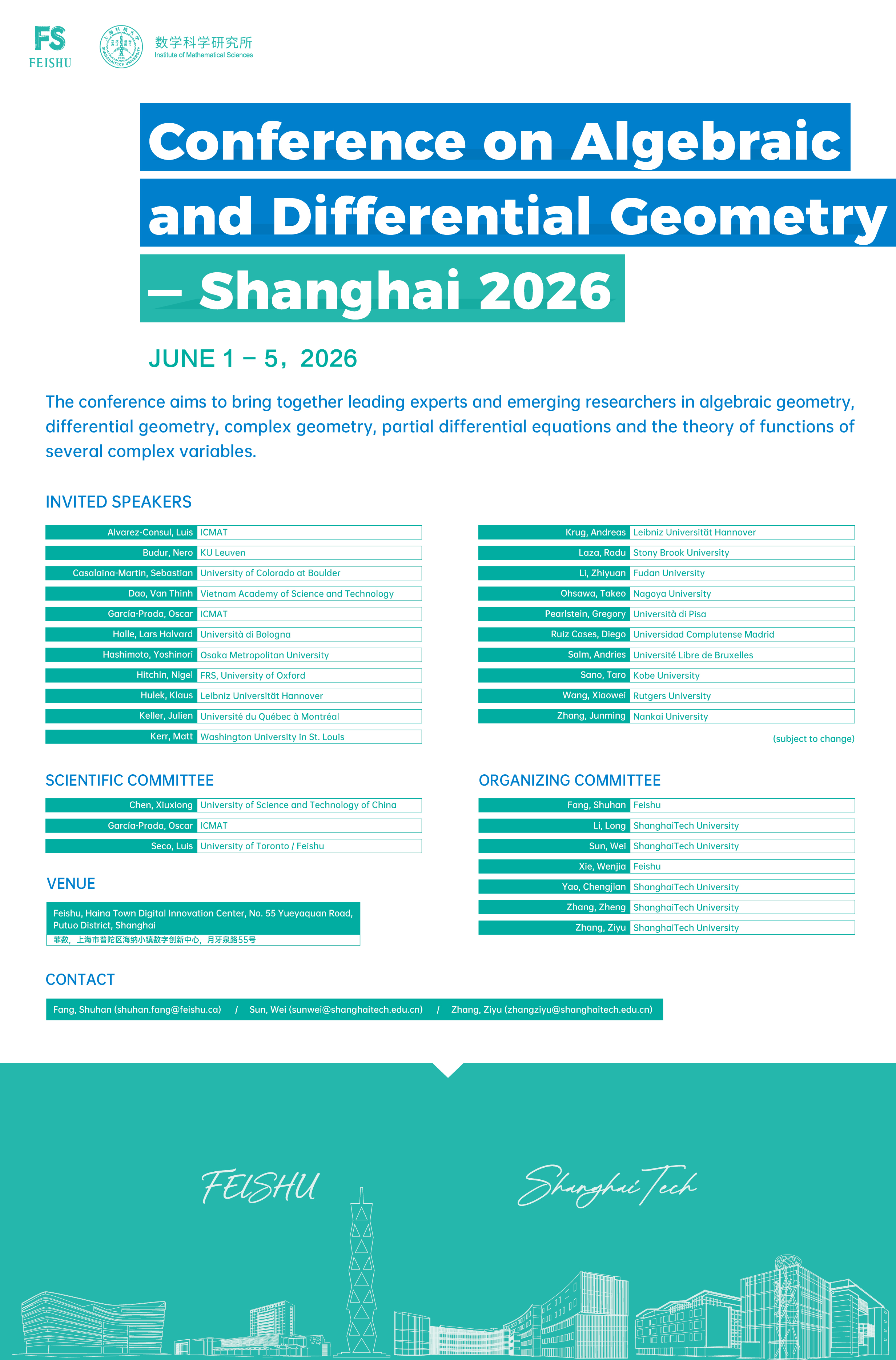
Conference on Algebraic and Differential Geometry — Shanghai 2026
Date: 2026-06-01 ~ 2026-06-05
Venue: Feishu, No. 55 Yueyaquan Road, Putuo District, Shanghai (Except Wednesday 3).
Event Type: International Conference.
Organizing Institutions: Feishu, ShanghaiTech University.
Overview
The Conference on Algebraic and Differential Geometry — Shanghai 2026 will be held in Shanghai from June 1 to June 5, 2026. The conference aims to bring together leading experts and emerging researchers in algebraic geometry, differential geometry, complex geometry, partial differential equations and the theory of functions of several complex variables.
With the participation of 21 invited speakers and additional attendees, the conference will provide a focused international platform for the exchange of recent research developments, the exploration of interactions between algebraic and differential methods, and the strengthening of collaboration between Chinese and overseas mathematical communities.
Scientific Committee
- Chen, Xiuxiong, USTC.
- García-Prada, Oscar, ICMAT, Madrid.
- Seco, Luis, University of Toronto / Feishu.
Organizing Committee
- Fang, Shuhan, Feishu.
- Li, Long, ShanghaiTech University.
- Sun, Wei, ShanghaiTech University.
- Xie, Wenjia, Feishu.
- Yao, Chengjian, ShanghaiTech University.
- Zhang, Zheng, ShanghaiTech University.
- Zhang, Ziyu, ShanghaiTech University.
Main Themes
The conference will feature lectures and discussions covering, but not limited to, the following areas:
- Algebraic Geometry.
- Moduli Spaces and Hodge Theory.
- Birational Geometry.
- Differential Geometry and Geometric Analysis.
- Kähler Geometry and Canonical Metrics.
- Complex Geometry and Several Complex Variables.
- Interactions between Algebraic and Differential Methods.
- FIND THE ABSTRACTS ON THE BOTTOM OF THE SITE -
Vision
The Conference on Algebraic and Differential Geometry — Shanghai 2026 aims to strengthen international collaboration, promote deep interaction between algebraic and differential geometry, and further establish Shanghai as a vibrant center for high-level mathematical research and academic exchange.
Distinguished speaker
- Hitchin, Nigel, FRS, University of Oxford.
List of speakers
- Álvarez-Cónsul, Luis, ICMAT, Madrid.
- Budur, Nero, KU Leuven.
- Casalaina-Martin, Sebastian, University of Colorado at Boulder.
- Dao Van Thinh, Vietnam Academy of Science and Technology.
- García-Prada, Oscar, ICMAT, Madrid.
- Halvard Halle, Lars, Università di Bologna.
- Hashimoto, Yoshinori, Osaka Metropolitan University.
- Hulek, Klaus, Leibniz Universität Hannover.
- Keller, Julien, Université du Québec à Montréal.
- Kerr, Matt, Washington University in St. Louis.
- Krug, Andreas, Leibniz Universität Hannover.
- Laza, Radu, Stony Brook University.
- Li, Zhiyuan, Fudan University.
- Ohsawa, Takeo, Nagoya University.
- Pearlstein, Gregory, Università di Pisa.
- Ruiz Cases, Diego, Universidad Complutense Madrid.
- Salm, Andries, Université Libre de Bruxelles.
- Sano, Taro, Kobe University.
- Wang, Xiaowei, Rutgers University.
- Zhang, Junming, Nankai University.
Registration
Scan the QR code to register!

Agenda
June 1, Monday | Feishu
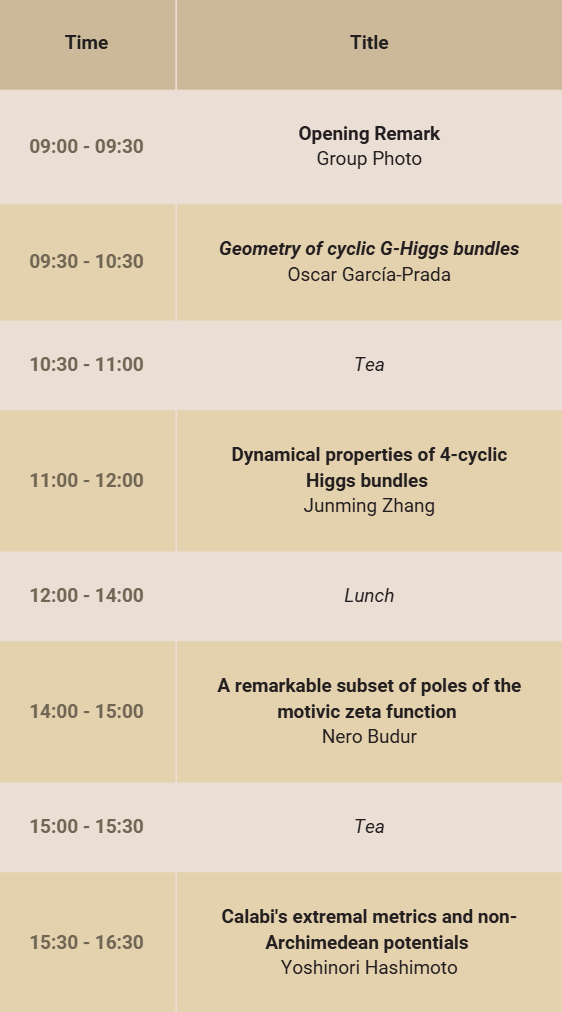
June 2, Tuesday | Feishu
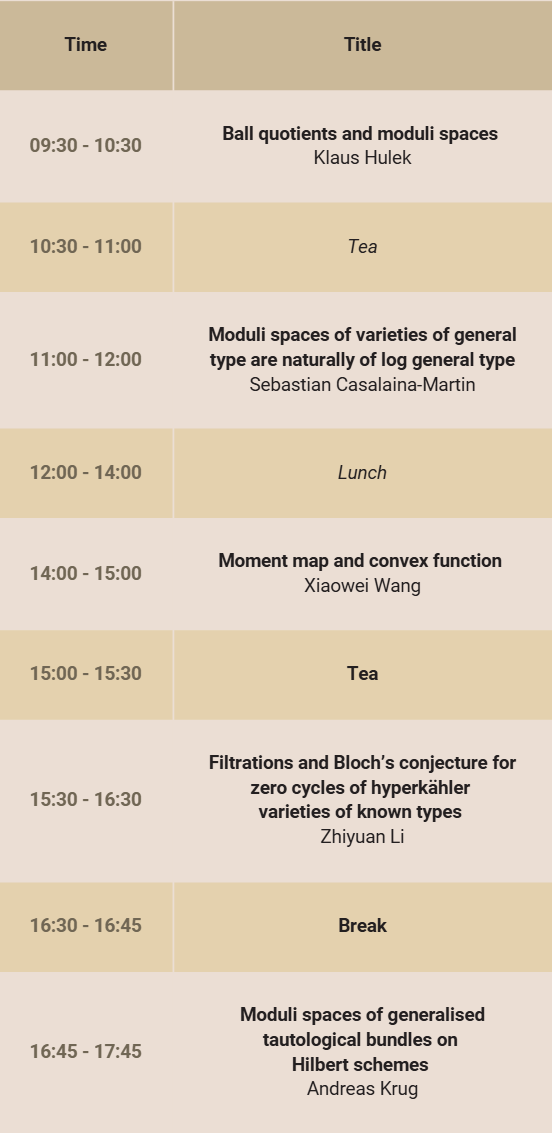
June 3, Wednesday | TBA
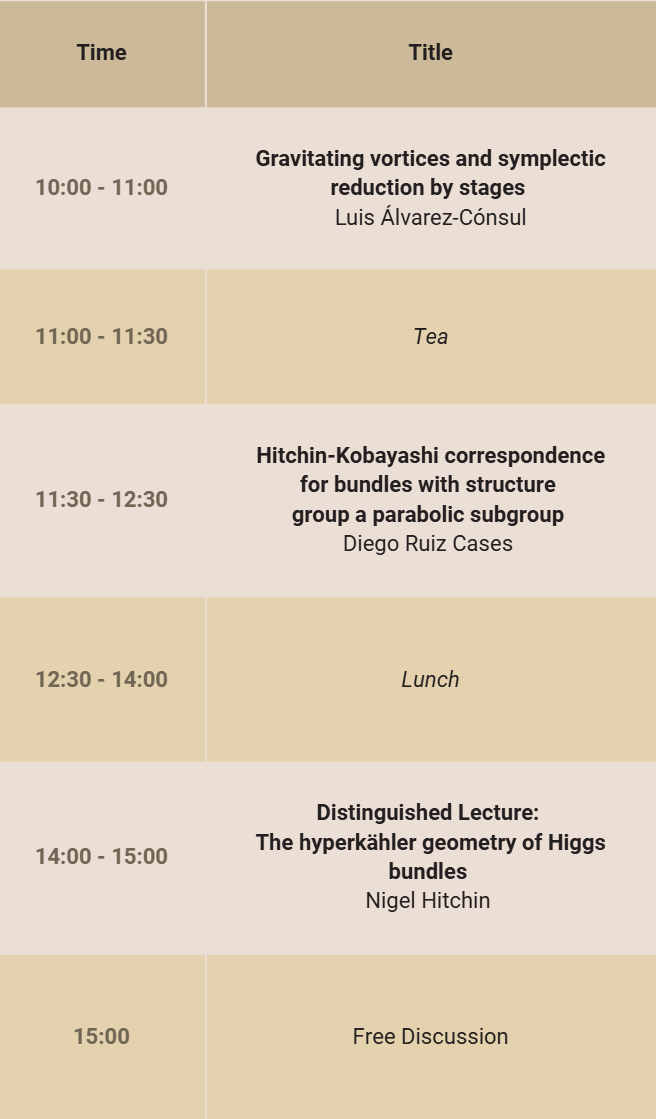
June 4, Thursday | Feishu
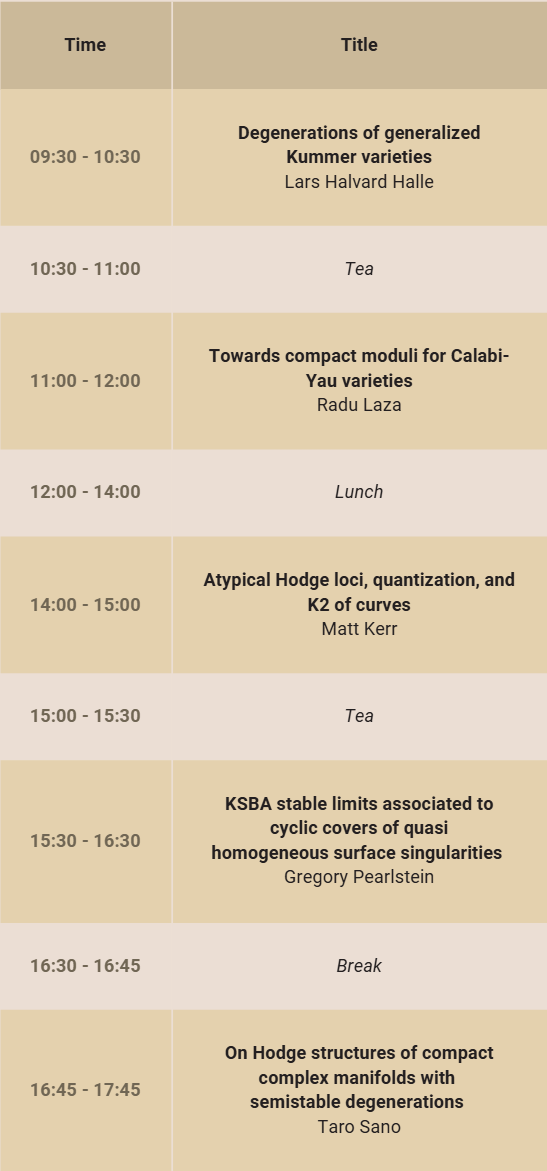
June 5, Friday | Feishu
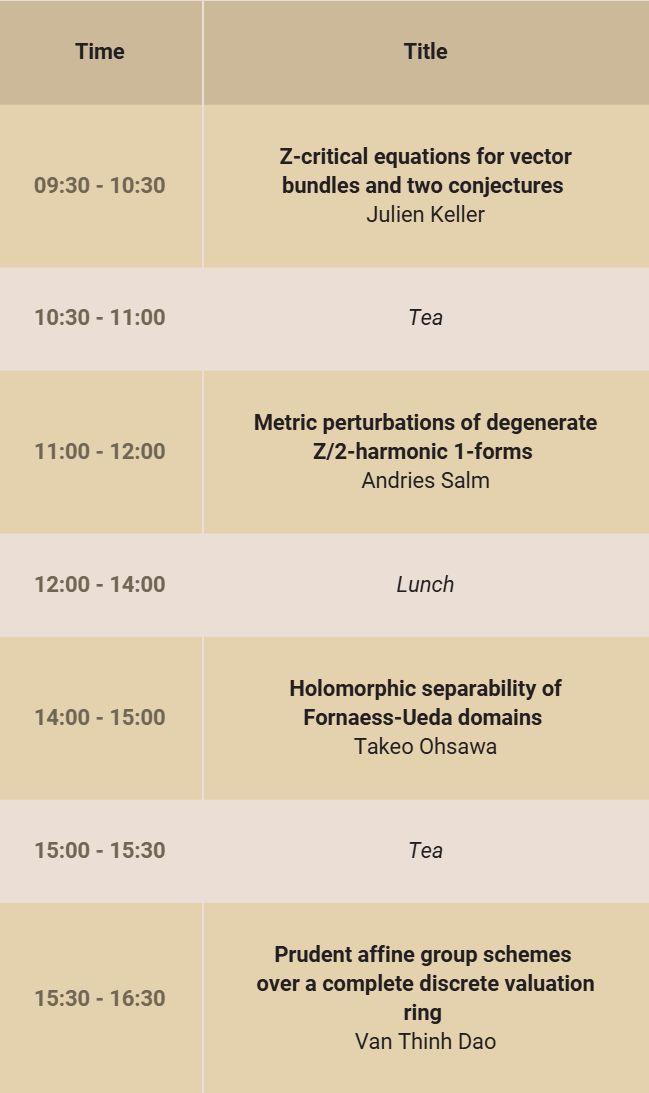
Abstracts
Gravitating vortices and symplectic reduction by stages | Álvarez-Cónsul, Luis | ICMAT, Madrid
The main geometric object in this talk is a moduli space parametrizing triples consisting of a Kähler metric on an oriented compact surface, a unitary connection on a hermitian line bundle, and a non-zero holomorphic section, satisfying a system of PDEs that model a class of cosmic strings introduced in physics by Nielsen and Olesen. Cosmic strings are static solutions to the field equations coupling gravity to Higgs scalars in a spontaneously broken gauge theory, that may have been formed at phase transitions as the universe cooled down shortly after the big bang. In this talk, I will study the problem of existence and uniqueness of solutions in the so-called critical Bogomolnyi phase. We use a variational approach that combines methods from reduction by stages in symplectic geometry and geometric invariant theory, with finite-energy pluripotential theory, as recently applied to constant scalar curvature Kähler metrics. This is joint work with Mario Garcia-Fernandez, Oscar Garcia-Prada, Vamsi Pritham Pingali and Chengjian Yao (arXiv:2406.03639 and JEMS).
A remarkable subset of poles of the motivic zeta function | Budur, Nero | KU Leuven
For any polynomial f with complex coefficients we find a remarkable subset of poles of the motivic zeta function. It is combinatorially determined by any log resolution and it admits intrinsic interpretations in terms of arcs and jets, and also in terms of Floer theoretic invariants. Joint work with E. de Lorenzo Poza, Q. Shi, H. Zuo.
Moduli spaces of varieties of general type are naturally of log general type | Casalaina-Martin, Sebastian | University of Colorado at Boulder
I will discuss some work, joint with Shend Zhjeqi, where we generalize work of Popa—Schnell and Wei–Wu on Viehweg hyperbolicity for families of varieties over smooth projective varieties to the case of smooth Deligne–Mumford stacks. The results of Popa—Schnell and Wei–Wu build on results of Viehweg–Zuo, Kebekus–Kovacs, Patakfalvi, and Campana–Paun. We apply our results to smooth moduli stacks showing that sufficiently general moduli stacks naturally have big log canonical bundles. We also consider implications for their coarse moduli spaces, and apply the results to several standard moduli spaces.
Prudent affine group schemes over a complete discrete valuation ring | Dao, Van Thinh | Vietnam Academy of Science and Technology
An affine group scheme is fully determined by its coordinate ring, which carries the structure of a commutative Hopf algebra. Among flat affine group schemes over a Dedekind ring, those whose coordinate rings are projective as modules over the base ring exhibit particularly favorable structural properties. In this talk, we focus on the case where the base ring is a complete discrete valuation ring (cDVR), and investigate criteria ensuring that an affine group scheme has a projective coordinate ring. A key notion in this context is prudence, introduced by Hai and dos Santos (IMRN 2021), which provides an equivalent condition that can be checked on finite quotients of the base ring.After recalling the definition of prudence for affine group schemes over a cDVR, we explain how this property can be verified in the setting of differential Galois groups. We then present recent joint work with P.H. Hai, J.P. dos Santos, and P.T. Tam on parameterized differential Galois groups.More precisely, we consider an irregular formal connection over R((x)), where R is a cDVR, and study whether the associated differential Galois (Tannakian) group scheme satisfies prudence. The rank-one case is now completely understood, while the higher-rank case remains largely open and presents several challenging problems.
Geometry of cyclic G-Higgs bundles | García-Prada, Oscar | ICMAT, Madrid
We consider the moduli space M(G) of G-Higgs bundles over a compact Riemann surface, where G is a complex reductive group. Typically, cyclic G-Higgs bundles are defined as fixed points for the action of a cyclic group Z/mZ given by multiplication of the Higgs field by a primitive m-th root of unity. There are, however, other actions of Z/mZ on M(G), leading to interesting and relevant fixed points, in particular, the combination of the previous action with an action on G. In this talk, I will discuss some aspects of the geometry of such cyclic G-Higgs bundles. Under some conditions, one can attach to such objects a Toledo type invariant, for which one has the Arakelov-Milnor inequality. This talk is based on past joint work with Ramanan, and Biquard, Collier and Toledo, and recent work with Miguel Gonzalez.
Degenerations of generalized Kummer varieties | Halle, Lars Halvard | Università di Bologna
Let A be an abelian surface. The summation of n points on A induces a map from the n-th Hilbert scheme Hilbn(A), to A. The (n-1)-th generalized Kummer variety is by definition the fiber of this map over the identity point of A. It is a smooth projective variety of dimension 2(n-1), and forms one of the fundamental types of Hyperkähler varieties. In this talk, I will present a method for constructing explicit degenerations of generalized Kummer varieties, for any n, when the underlying abelian surface admits a type 2 Kulikov degeneration. I will moreover discuss some features of these degenerations. This is joint work with K. Hulek and Z. Zhang.
Calabi's extremal metrics and non-Archimedean potentials | Hashimoto, Yoshinori | Osaka Metropolitan University
The extremal metric, introduced by Calabi, is a canonical metric on a Kähler manifold which can be regarded as a generalisation of Kähler-Einstein metrics and constant scalar curvature Kähler metrics. An important problem is to find a criterion for the existence of extremal metrics on a given Kähler manifold, and a leading conjecture in this area, due to Yau, Tian, Donaldson, and Székelyhidi, states that the existence of an extremal metric can be characterised by an algebro-geometric stability condition. A breakthrough result by Li proves that the existence of a constant scalar curvature Kähler metric follows from a certain completion of this stability condition. In this talk, we generalise Li’s result to extremal metrics.
The hyperkähler geometry of Higgs bundles | Hitchin, Nigel | FRS, University of Oxford
Calabi introduced the terminology of hyperkähler manifolds and produced the first higher dimensional complete example on the cotangent bundle of complex projective space. The moduli space of Higgs bundles on a Riemann surface has a much-studied hyperkähler metric which has some common features with Calabi's example. The talk will focus on a real-valued function associated to a circle action, applicable in both cases, and show how to use it to describe the geometry of the Higgs bundle moduli space as the complex structure of the Riemann surface varies.
Ball quotients and moduli spaces | Hulek, Klaus | Leibniz Universität Hannover
A number of moduli spaces have a ball quotient model. These include cubic surfaces, cubic threefolds, some moduli spaces of lattice-polarized K3 surfaces with prescribed automorphism group and Deligne-Mostow varieties. The latter are configuration spaces of weighted points on P1. There are two ways how one can construct these spaces. One is via GIT, the other is via Hodge theory. These approaches lead to different natural compactifications such as the GIT-quotient of polystable objects and its Kirwan blow-up on the one hand and Baily-Borel compactifications and toroidal compactifications on the other hand. In this talk I will discuss the geometry of some of these spaces and the relation between the various compactfications. In this talk I present joint work with several coauthors: S. Casalaina-Martin, S. Grushevsky, S.Kondo, R. Laza and Y. Maeda.
Z-critical equations for vector bundles and two conjectures | Keller, Julien | Université du Québec à Montréal
For a holomorphic vector bundle over a compact Kähler manifold, the notions of a Z-critical metric and a Z-positive metric have recently been introduced. In this talk, I will discuss the relationship between these differential-geometric notions and the algebraic notions of Z-stability and strong Z-positivity of the underlying bundle, with particular emphasis on the case of vector bundles over projective surfaces.
Atypical Hodge loci, quantization, and K2 of curves | Kerr, Matt | Washington University in St. Louis
The Milnor K-theory of families of curves gives a useful "toy model" for conjectures in atypical intersection theory, mirror symmetry, and arithmetic geometry. It also gives a source for higher normal functions, which are the simplest kind of variation of mixed Hodge structure. In this talk we explain two recent results: (1) a finiteness result for the (atypical) torsion loci of these normal functions, which is closely related to A-polynomials of knots; and (2) a quantum spectral interpretation of their (mixed) attractor loci. We will then combine (1) and (2) to say something surprising about their zero-loci. This talk draws on joint work with RJ Acuña, Devin Akman, Alessio Corti, Chuck Doran, John McCarthy, and Soumya Sinha Babu.
Moduli spaces of generalised tautological bundles on Hilbert schemes | Krug, Andreas | Leibniz Universität Hannover
We construct new stable vector bundles on Hilbert schemes of points on algebraic surfaces, which are parametrised by connected components of their moduli spaces. This work generalises aspects of our previous work on tautological bundles and of recent work of O’Grady. This talk is based on joint work with Fabian Reede and Ziyu Zhang.
Towards compact moduli for Calabi-Yau varieties | Laza, Radu | Stony Brook University
A central problem in algebraic geometry is the construction of meaningful compactifications for the moduli spaces of algebraic varieties. While the moduli of varieties of general type and Fano varieties are now largely understood via KSBA theory and K-stability respectively, the K-trivial case is profoundly more subtle, effectively sitting at the limit of these two cases. To tackle this, a powerful alternative perspective emerges based on Hodge theory and period maps. While this framework classically governs the moduli of abelian varieties, K3 surfaces, and hyperkähler manifolds via Baily–Borel theory, extending it to Calabi-Yau varieties has historically been a major challenge. In this talk, after reviewing this Hodge-theoretic approach and recent breakthroughs in constructing compact moduli for Calabi-Yau varieties, I will focus on exploring the geometric meaning of these Baily-Borel type compactifications.
Filtrations and Bloch’s conjecture for zero cycles of hyperkähler varieties of known types | Li, Zhiyuan | Fudan University
In this talk, I will discuss Bloch's conjecture for birational automorphisms of hyperkähler varieties of K3n type and generalized Kummer type. I will explain the underlying philosophy in two parts. First, how to reduce the problem to Bloch’s conjecture for (anti-)autoequivalences of twisted surfaces. Second, the construction of the “correct” Beauville–Voisin filtration on zero cycles for these hyperkähler varieties. This philosophy works for the hyperkähler varieties arising from Bridgeland moduli spaces. The talk is based on joint works with X. Yu & R. Zhang, with Z. Chen, R. Zhang & X. Zhang, and most recently ongoing work with Z. Chen & X. Zhang.
Holomorphic separability of Fornaess-Ueda domains | Ohsawa, Takeo | Nagoya University
In 1977, Behnke-Thullen's union problem was solved negatively by Fornaess and Ueda, independently. They constructed non-Stein complex manifolds which are increasing unions of Stein manifolds. They are not holomorphically convex.
It will be shown that nevertheless they are holomorphically separable.
KSBA stable limits associated to cyclic covers of quasi-homogeneous surface singularities | Pearlstein, Gregory | Università di Pisa
We establish an explicit framework for computing stable surface degenerations on the boundary of the moduli space of cyclic covers of weighted projective planes P(1,a,b) branched along curves with quasi-homogeneous singularities. As an application, we construct numerous codimension-one boundary strata parameterizing stable surfaces associated to quasi-homogeneous singularities arising from the 95 families of weighted K3 surfaces classified by Reid and Yonemura. In particular, we identify 7 new classes of KSBA boundary components for the moduli space of I-surfaces, realized as double covers of P(1,1,2) branched along a curve of degree 10.
Hitchin-Kobayashi correspondence for bundles with structure group a parabolic subgroup | Ruiz Cases, Diego | Universidad Complutense Madrid
The Hitchin-Kobayashi correspondence relates the existence of solutions to a gauge equation (the Hermitian Yang-Mills equation) for a unitary connection on a holomorphic principal bundle with a reductive structure group and a notion of stability coming from algebraic geometry. We will discuss how to extend the Hitchin-Kobayashi correspondence to holomorphic principal bundles whose structure group is a parabolic subgroup of any given connected complex reductive group (joint work with Oscar García-Prada).
Metric perturbations of degenerate Z/2-harmonic 1-forms | Salm, Andries | Université Libre de Bruxelles
Z/2 harmonic 1-forms are generalizations of harmonic 1-forms that allow topological twisting around a subspace of codimension 2. These objects were introduced by Taubes to compactify the moduli spaces of solutions to generalized Seiberg-Witten equations, and they show up in many other gauge theoretical problems.
Donaldson showed there is a deformation theory for so-called non-degenerate Z/2-harmonic 1-forms. In this presentation we study the perturbations of the remaining degenerate solutions. For a natural class of degenerate examples, we prove that after a suitable perturbation of the ambient Riemannian metric, the form can be deformed to a nearby non-degenerate Z/2-harmonic 1-form.
On Hodge structures of compact complex manifolds with semistable degenerations | Sano, Taro | Kobe University
Compact Kähler manifolds satisfy several nice cohomological properties such as Hodge symmetry and Hodge-Riemann bilinear relations. Friedman and Li recently showed that non-Kähler Calabi-Yau 3-folds which are obtained by conifold transitions of projective ones satisfy such properties.
I will present examples of non-Kähler Calabi-Yau manifolds with such properties by smoothing normal crossing varieties and explain how we obtain such nice Hodge-theoretic properties.
Moment map and convex function | Wang, Xiaowei | Rutgers University
The concept moment map plays a central role in the study of Hamiltonian actions of compact Lie groups K on symplectic manifolds (Z,ω). In this talk, we propose a theory of moment maps coupled with an AdK-invariant convex function f on , the dual of Lie algebra of K, and study the structure of the stabilizer of the critical point of f Ο μ with moment map μ:Z→ . As an outcome, we are able to obtain a Calabi-Matsushima decomposition in this new framework. This work is motivated by the work of Donaldson on Ding functional, which is an example of infinite dimensional version of our setting. In particular, we obtain a natural interpretation of Tian-Zhu's generalized Futaki-invariant and Calabi-decomposition.
Dynamical properties of 4-cyclic Higgs bundles | Zhang, Junming | Nankai University
Given a compact Riemann surface X, the celebrated non-Abelian Hodge correspondence establishes a correspondence between reductive representations of the fundamental group of X into a Lie group and polystable Higgs bundles. In his pioneering work, N. Hitchin introduced Hitchin components via Higgs bundles as higher-rank analogues of the Teichmüller space. Later, F. Labourie introduced the notion of Anosov representations and proved that the representations in Hitchin components are Anosov. Consequently, they are discrete, faithful, and their orbit maps are quasi-isometric embeddings. In general, however, it is difficult to determine whether the representation associated with a given Higgs bundle has such dynamical properties, beyond the Hitchin components and other known higher Teichmüller spaces. In this work, we establish such dynamical properties for representations arising from a specific family of 4-cyclic Higgs bundles.